


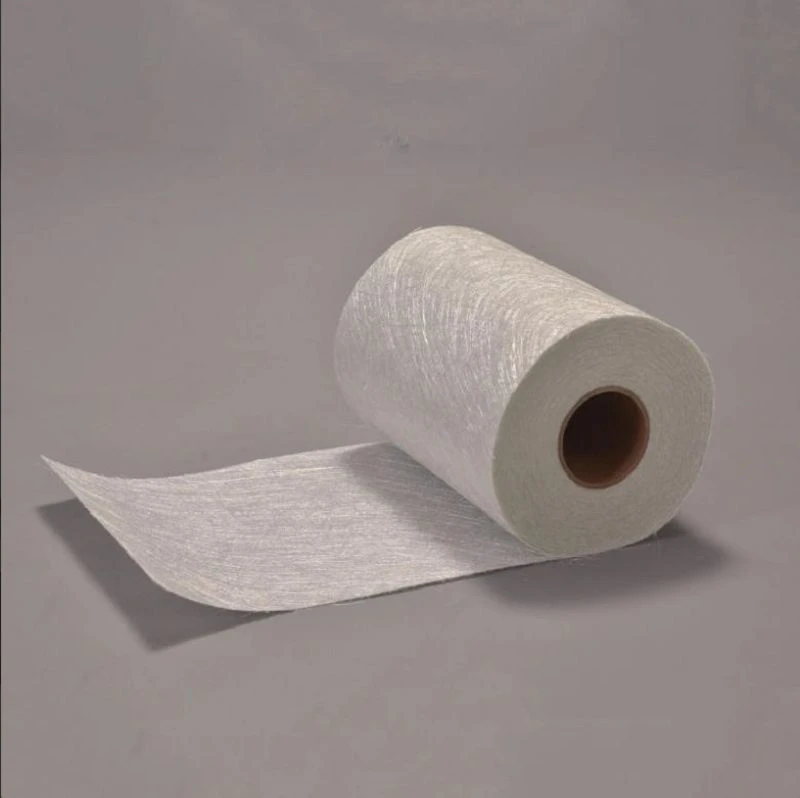
Fiberglass Surfacing Veil
Danyang Yonggu Building Materials Co., Ltd. is one of the most reliable manufacturers and suppliers of fiberglass surfacing veil in China. With abundant experience, we warmly welcome you to wholesale bulk fiberglass surfacing veil made in China here from our factory. All customized products are with high quality and competitive price.
Product Description
Fiberglass Surfacing Veil is a lightweight nonwoven glass fibre layer used as the surface reinforcement of FRP laminates and composite mouldings. It is produced from randomly distributed E-glass fibres bonded with an organic binder, allowing the veil to wet out rapidly with polyester, vinyl ester and epoxy resin systems.
The veil is positioned on the mould surface rather than within the structural laminate. After resin impregnation it forms a compact resin-rich layer that covers the reinforcement beneath. This outer layer improves surface uniformity and reduces direct exposure of structural glass fibres to moisture, chemicals and weathering.
Unlike woven fabrics or chopped strand mats, surfacing veil is not selected for structural load carrying. Its function is associated with surface quality, resin distribution and long-term protection of the laminate.
Material Construction
- Base material:Randomly distributed E-glass fibres
-
Construction:Nonwoven fiberglass veil
-
Binder:Organic binder compatible with thermosetting resins
-
Supply form:Roll goods
The binder content and fibre distribution are controlled during manufacture to maintain uniform resin flow throughout the veil. This becomes particularly important where moulded parts require consistent surface appearance over large production runs.

Laminate Behaviour
During moulding, resin penetrates the veil before reaching the structural reinforcement underneath. Once cured, the veil becomes the outermost layer of the composite.
This layer masks the fibre pattern produced by heavier reinforcement fabrics and reduces the likelihood of print-through as the laminate ages. Resin shrinkage is also distributed more evenly across the moulded surface.
From our experience, manufacturers generally notice the difference after demoulding rather than during lay-up. Surface finishing usually requires less correction where fibre distribution remains uniform throughout the veil.
Another point worth considering is resin selection. Polyester, vinyl ester and epoxy systems each produce slightly different surface characteristics, even when the same veil specification is used.
Material Characteristics
- The random fibre network promotes rapid resin impregnation without restricting laminate production.
-
Low area weight allows the veil to improve surface quality with minimal influence on laminate thickness.
-
The cured resin layer provides additional protection against moisture, weathering and many industrial chemicals, depending on the selected resin system.
-
Because the glass fibres remain evenly distributed, the finished laminate develops a more uniform appearance and fewer visible fibre marks.
-
The fiberglass surfacing veil is compatible with hand lay-up, spray-up, vacuum infusion, resin transfer moulding, pultrusion and filament winding processes.
Reference Specifications
|
Material |
E-glass |
|
Weight |
20–100g/㎡ |
|
Thickness |
0.10–0.50mm |
|
Width |
1000–2000mm (customizable) |
|
Length |
50–200m/roll |
|
Temperature resistance |
120–250℃ |
|
Tensile strength |
MD ≥300–1200N/5cm |
|
Binder |
Acrylic |
Typical Applications
Fiberglass Surfacing Veil is incorporated into a broad range of composite products where surface finish and laminate durability are important.
Common applications include FRP wall panels, pipes, storage tanks, cooling towers, sanitary products, pultruded profiles, filament-wound components and architectural composite panels.
Marine mouldings, transportation components and wind energy parts also use surfacing veil to improve the quality of exposed composite surfaces. The specification selected for these products normally reflects the moulding process, resin chemistry and required surface finish rather than a single standard construction.
Manufacturing Options
Production parameters are adjusted according to the intended composite process.
Area weight, binder chemistry, roll width, core diameter and packaging format may all be specified before manufacture. Some customers require faster resin wet-out for infusion processes, while others place greater emphasis on surface smoothness or post-finishing efficiency.
Where a production line operates with a defined resin system or moulding cycle, the fiberglass surfacing veil specification can be matched to those processing conditions before delivery rather than modified during manufacture of the finished composite part.
Hot Tags: fiberglass surfacing veil, China fiberglass surfacing veil manufacturers, suppliers, factory, Alkali Resistant Fiberglass Tissue, Fiberglass Surface Mat, Fiberglass Surfacing Veil, fiberglass tissue, Fiberglass Tissue Mat, Fiberglass Veil
You Might Also Like


Send Inquiry